Ashes of a memory

That night would mark another year since her husband was taken away. He had gone to buy cigarettes. The night he disappeared she only found his lighter in the street. It was a gift she herself had had made. It had both of their initials and the date they met engraved on the silver dye. No two were alike.

They had no children and did not spend much time together. They barely spoke or even touched each other, but they where in love. He loved her. That night had just been another twist of fate, he had been taken from her and now he must be dead. “Bastards!” She thought, they hadn’t even sent her a ransom note, not a finger nor an ear. Only the sentence to deny her ever seeing her husband again.

More than once she believed she saw his ghost. He looked very much like the one who used to be her husband, but it couldn’t be him. He appeared with another woman and avoided her gaze at all costs. No, it was not him. Her husband loved her.

That year was as good a year as any to let him go. She was tired of waiting for him to come back one day. After so long the hope was gone. In the absence of a body, she took those belongings he had left behind: a book that had been on his nightstand for years, a couple of photographs, a deck of cards, and some socks. She even went to the store to buy a box of the cigars he used to smoke. She didn’t want the smell she missed so much to be absent that night.

She took the lighter she had given him and burned it all. With the ashes she filled a cup, the one he used to use in the mornings. That was as close to a goodbye as she could ever get. He took the urn and covered it up with plastic wrap. She was going to make a trip to what used to be their corner away from the world.

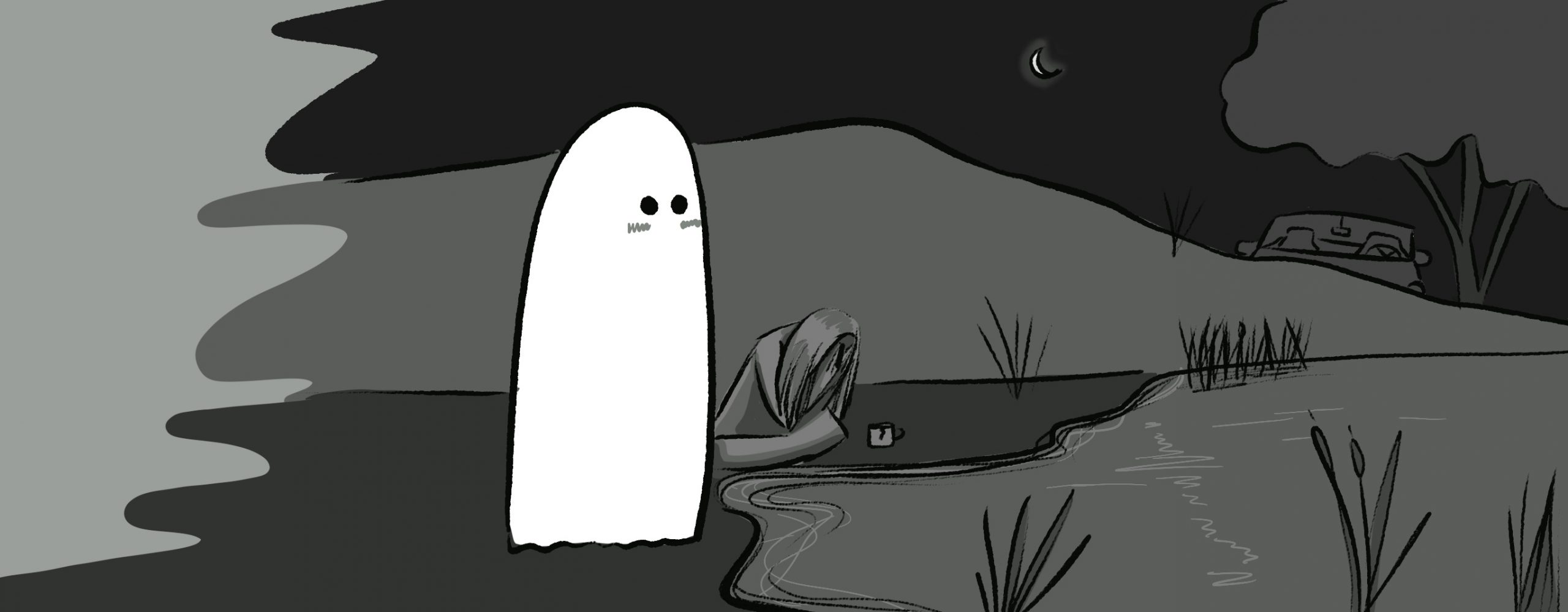
At nightfall she took the car and drove in the direction of a small pond on the outskirts of the city, it was neither a magical or particularly beautiful spot, it was simply the place where two people who loved each other went from time to time.

On the way she drove through a hole and the car bounced aggressively. So much movement caused the cup carrying her husband to break a little.

The woman was focused on holding back her tears and driving to the place she needed to go to say goodbye to the man she loved. She didn’t notice anything else around her. She had the windows down and the radio blaring. The ash was escaping through the window in small doses.

By the time she reached the pond, there was nothing left. For the second time her husband had been taken away without her being able to say goodbye.
The importance of having hobbies to keep creativity flowing

Creativity is not exclusive to artists and designers. It is a tool that is useful to all fields in which we can perform both occupationally and socially. One of the main advantages of exercising our creative side is to find solutions and innovate when obstacles arise.

One way I keep my creativity active that has nothing to do with art is to have hobbies that hold me back. Being bad at a new activity is normal and inexperience often gives us a great creative edge, because we don’t know if what we are coming up with will be overlooked by someone more experienced. Ingenuity often goes hand in hand with audacity and this allows us to try without fear of failure, because at the beginning we rarely have anything to lose.

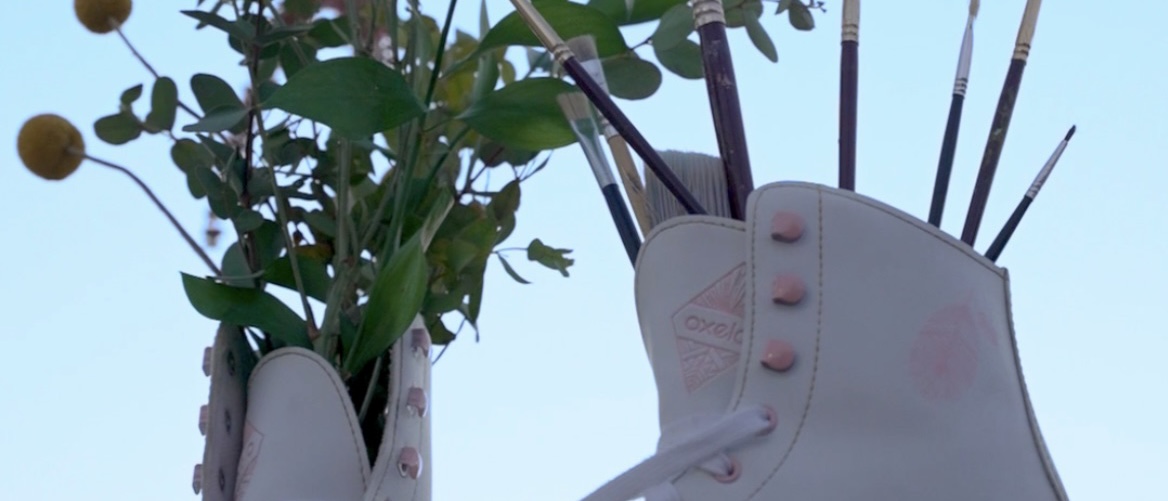
In my case some of the hobbies that help me to stay afloat are: sports, I practice frontennis and I have noticed how it helps me to get out of my routine, it helps me to think in different ways and to activate me out of the usual schedule; I also like rollerskating; cooking and playing board games, especially if they are strategy games.

When I feel like I have a creative block and I don’t know where to begin, doing any of these activities is usually very helpful.

My first art exhibition

In April 2021 I held my first art exhibition entitled “Rosa”. Here I will tell you about my creative process and the steps I followed to carry out the event.

It all started with a little painting (I like to connect with my friends by giving them little paintings to carry in their phone or wallet). It was one in the shape of a cactus on a pink background. In a yoga class, the teacher offered to read it as if it where some sort of tarot card, and told me that she saw in it that I was very protective of love with barriers so I wouldn’t get hurt. This interpretation triggered a series of reflections on how I perceived and understood love. It is a subject that I believe is very important for us as humans.

The Process
Little by little I developed each concept of what I felt was important for me to explore. In my notebook I made sketches of different ideas, interpretations and determined which pieces I wanted to work on for this first exhibition. Once I had it all more or less thought out, I began to paint those that I had already landed on the ground. Little by little I developed each work, some of them I changed them completely when I was presented with new materials, when I started painting or when I spent a few days with them.

Along the way I made a lot of mistakes, some were for the better and others just made me work twice as hard, although I learned something from all of them. It took me about six months to finish all the artworks. Once I started on the last pieces I set a date for the event. My birthday was in April and it seemed like a good excuse to show my first art exhibition to my family and friends. Due to the pandemic it had to be a very limited event, but it helped me to overcome my first severe case of imposter syndrome, also to get people to start seeing me as a serious artist and to break the barrier of putting something so personal in front of people’s judgment.

The installation
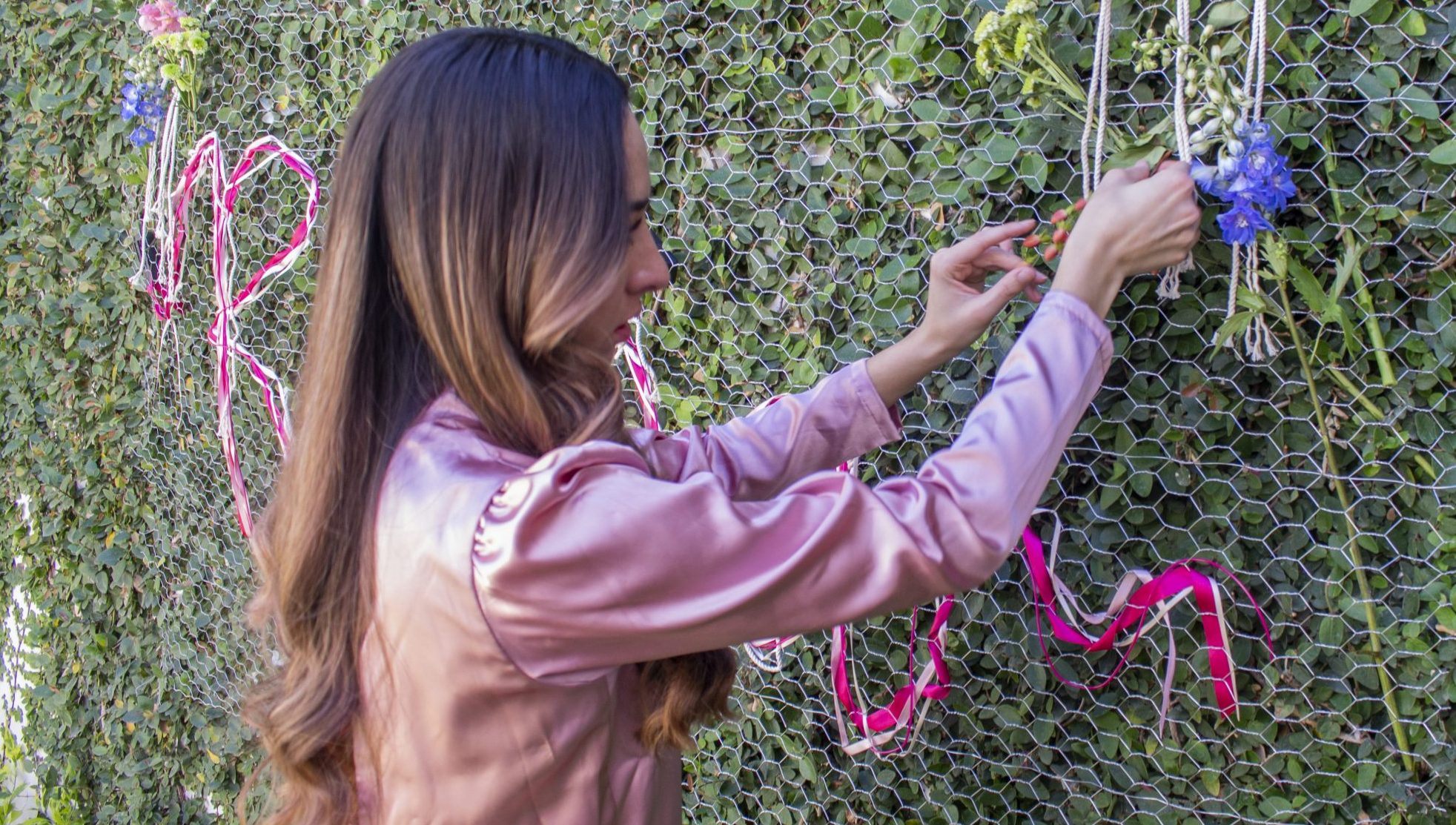
For the event I took two old doors that were in my house and painted them pink, made a sign with flowers and neon wires with the title of the exhibition and served rose wine. I really cared about creating an atmosphere that invited people to engage with the exhibition. At the end of the tour I put a poster board with pink materials on hand so people could leave a small intervention. For one night my garage became a temporary gallery. To spread the word, I called newspapers and social magazines to cover my event so that I could reach more people despite the limited health situation.

What I learned from this experience is that there are going to be people who like what you do and people who don’t like what you do. That’s great, the varied opinions enrich the experience. I also realized that I am very fortunate to have people around me who support me. I learned about planning, new techniques and about myself.

Perfect faces

Many times when we start drawing faces we think a lot about the question of perfect proportions, for example, that the lips go from the middle of the iris to the middle of the iris of the other eye. That the ears reach where the nose begins, etc. These facts can be useful, but in my opinion also boring.

I think art is about showing our interpretation of things and making them how we perceive them. Our face is asymmetrical and we all have peculiarities that make us special and interesting, those peculiarities can get lost when trying to make them fit the “rules” of proportion of the human body and instead of our illustration looking realistic, it can end up looking soulless.

To have good proportions when making something using a reference, it is best to use techniques such as putting your arm straight in front of you while holding a pencil or something that can serve as a reference.

I had a teacher who always said that we see human bodies and faces every day, we carry the proportions engraved inside us, we better concentrate on capturing gestures and emotion, I liked this perspective, but in the end everyone has their own criteria and is free to follow the parameters that best suit them.

Practical tips for painting with gouache

I love this material because it has a lot of versatility and because of the matte finish of its colors but with a lot of saturation.

  • To begin with, find the ideal density for your work. You can dilute it as much as watercolors or use it out of the tube to make it thick like acrylics. My favorite way to work with them is with a little water, until it feels like a liquid paste but not too watery.
  • It is a paint that reactivates with water, so be careful when working in layers.
  • Experiment a lot. Try different methods and techniques on a sheet just to get familiar with the material before you do any designs.
  • In my experience, the brands I have liked the most are Acryla gouache which is more difficult to reactivate with water, Windsor and Newton and Himi.
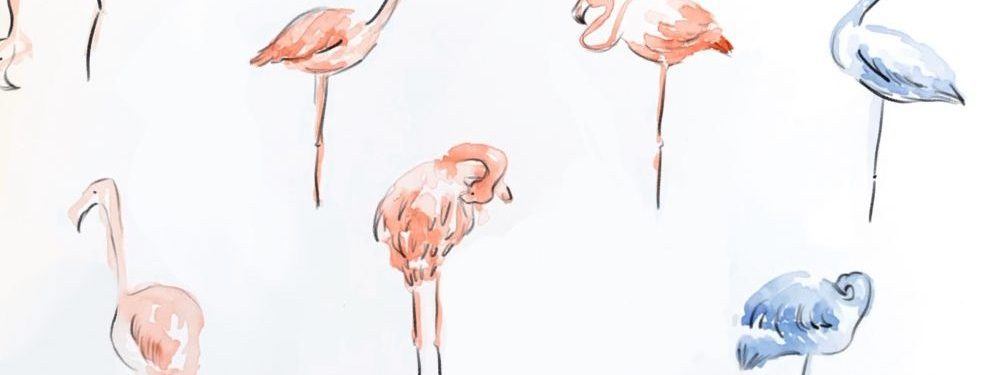
Life drawing Flamingos

Three tips for painting with watercolors

  1. Watercolors are very difficult to correct. Start painting from the lightest to the darkest tone.
  2. Use a paper with a lot of cotton to better support the load of water, heavyweight fabriano is a very good choice.
  3. Before jumping to paint something concrete I recommend that you experiment with different watercolor techniques on a piece of paper: use a lot of water, use little water. Paint wet over another color, do the same when the first color is dry. Try everything you can think of or see in tutorials so that you become familiar with the technique and can work with more control over the medium.

Bonus: complement the watercolor with colored pencils to add texture to the painting.